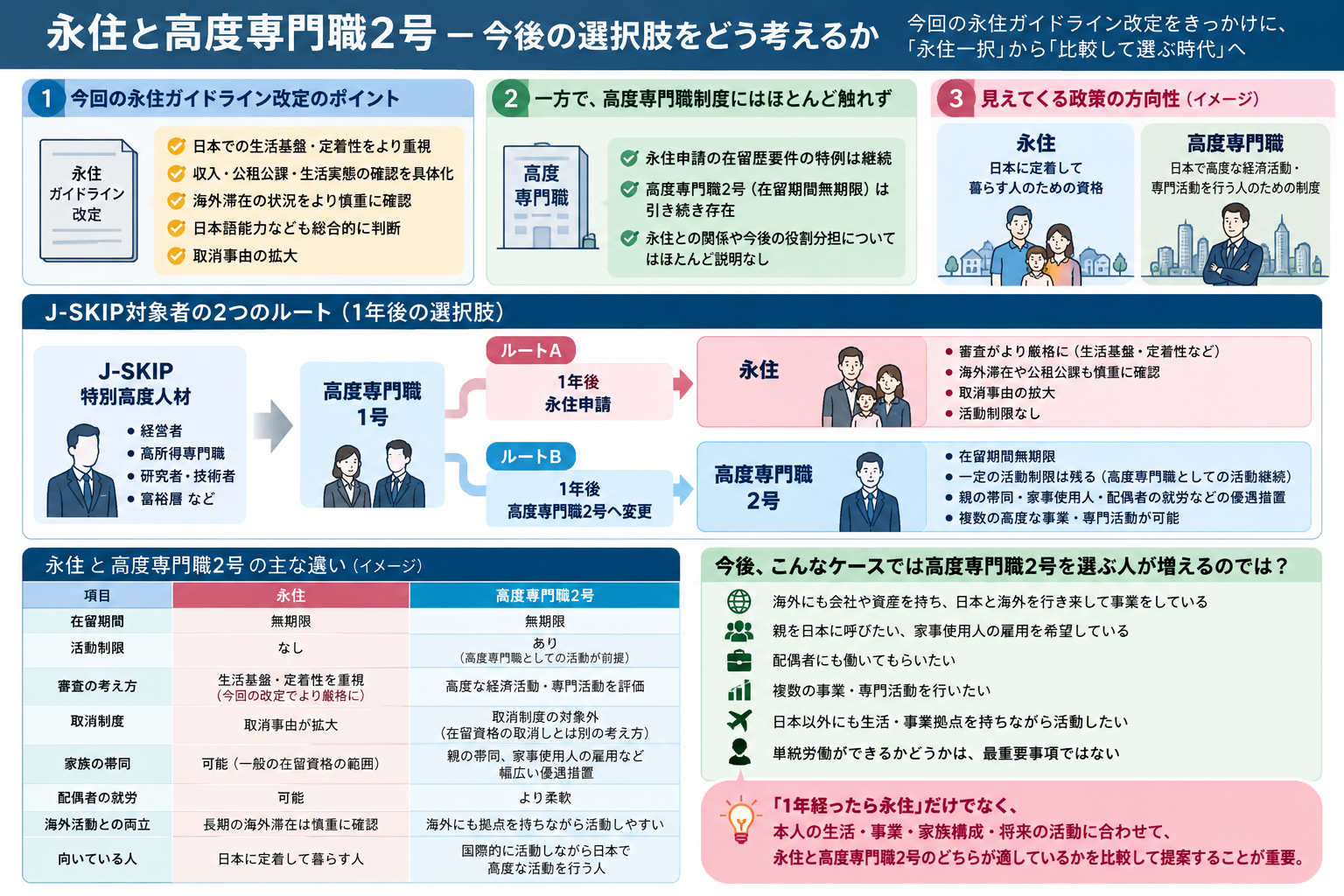
The October 2026 revision of Japan's permanent residence guidelines raises an important question: how should highly skilled foreign professionals think about the relationship between permanent residence and Highly Skilled Professional status going forward?
The revised guidance organizes permanent residence more clearly around income, taxes and social insurance, the applicant's living base in Japan, overseas stays and other indicators of long-term settlement. By contrast, the Highly Skilled Professional framework is designed to reward high-level management, professional, technical and research activities in Japan.
Permanent residence is increasingly about settlement
Permanent residence is becoming more clearly associated with people whose real center of life is in Japan. Long periods abroad, a weak living base in Japan, or unstable income and public-charge compliance may receive closer scrutiny. The question is no longer simply whether permanent residence avoids renewals, but whether the applicant is genuinely settled in Japan.
HSP is about high-level activity in Japan
Highly Skilled Professional status has a different character. It can fit executives and professionals who operate internationally, maintain companies or assets abroad, travel frequently, or value benefits relating to spouses, parents and domestic workers. For some people, that design may fit their actual life better than permanent residence.
Permanent residence for those settling in Japan; HSP for those carrying out high-level activities in Japan while remaining internationally active.
Is permanent residence always better than HSP (ii)?
Permanent residence has major advantages, especially the absence of activity restrictions. But HSP (ii) also has an indefinite period of stay and retains substantial preferential treatment. For a high-income executive, researcher or technical professional, benefits for family life and internationally mobile work may matter more than having unrestricted access to every type of employment.
J-SKIP creates two one-year routes
For qualifying J-SKIP applicants, one year under HSP (i) may open two distinct paths: permanent residence or HSP (ii). That means the next step should not be automatic. The better choice depends on the person's future residence pattern, overseas business, family needs, spouse's work, domestic-worker needs and planned activities in Japan.
HSP (i) → 1 year → Permanent Residence
HSP (i) → 1 year → HSP (ii)
HSP (ii) may become a destination in its own right
Historically, many applicants viewed HSP as a stepping stone to permanent residence. But as permanent residence rules become more focused on actual settlement, HSP (ii) may be reevaluated as a complete long-term status for internationally active highly skilled people.
The key question is not which status is 'higher'. It is which status better matches the person's life, business and family structure.